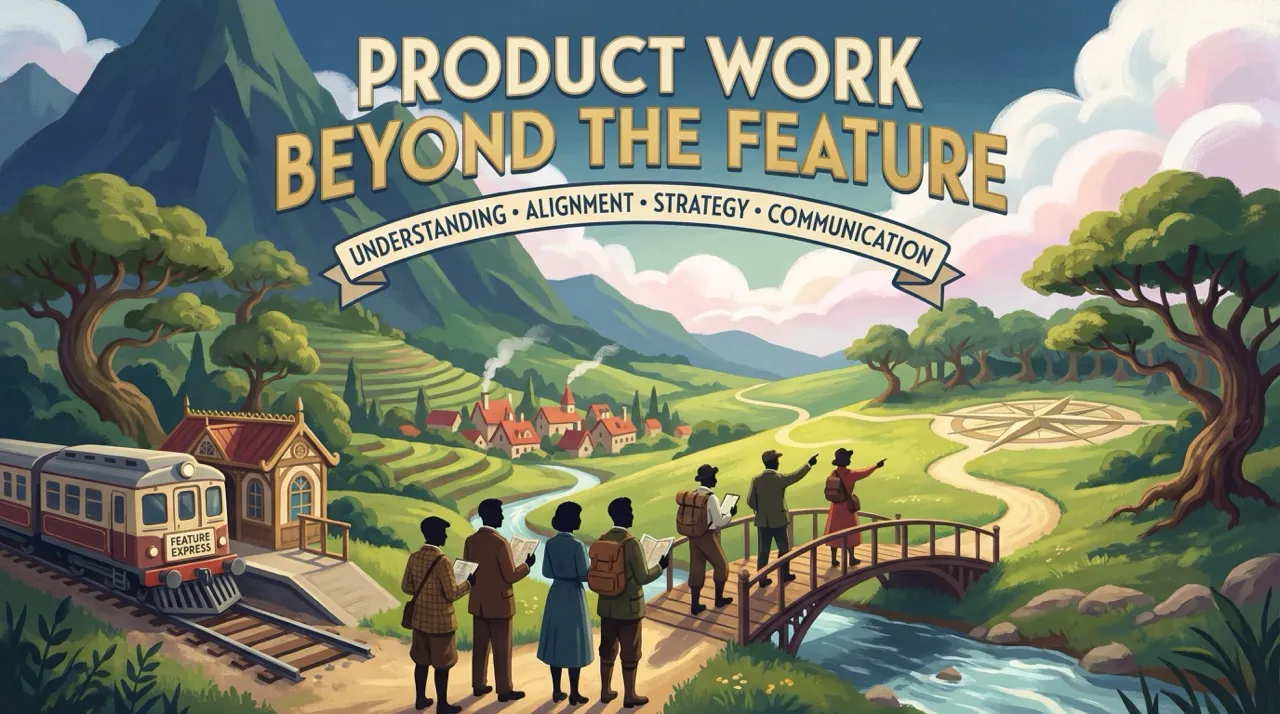
Product Work Beyond the Feature
Ship 50 features and nobody notices. Ship 5 the right way and your product feels alive.
The difference isn't engineering. It's everything around the engineering: the problem you chose to solve, how you measured success, and whether anyone heard about it after launch. Most PMs optimize for output. The best ones optimize for the work that happens before and after the code.
Start with Problems, Not Features
Great product thinkers don't start by asking "What should we build?" They begin with "What problem are we really solving?" This simple shift changes every decision that follows.
At the core of product thinking is a deep understanding of user needs, motivations, and frustrations. It's about empathy and research, not checklists and tickets. Understanding customers through direct observation, interviews, and data helps uncover what's truly valuable—not just what's requested.
This doesn't mean ignoring feature requests. It means interpreting them as clues, not solutions.
Product Mindset Beats Task Mindset
Being a product manager is not about completing tasks on a board. It's about creating outcomes.
A product mindset focuses on value creation and impact over output. It asks tough questions like:
- Why are we doing this?
- How will this move our users or business forward?
- What will we measure to know it worked?
Shifting from a feature checklist to an outcome-oriented mindset helps teams build with intention, avoid waste, and focus on what truly matters.
Strategy Underpins Everything
Features are tactical artifacts that should serve strategic goals. Without strategy, features become disconnected, reactive, and hard to justify.
Product strategy is a high-level plan that connects product vision, user needs, and business goals. A solid strategy gives teams clarity about why they build things and how they will measure success. It helps prioritize work that moves meaningful metrics instead of incremental bells and whistles.
When teams grasp the why, the what and how become easier to decide.
Feedback Loops and Learning
Building a feature is not the end of the work. Valuable product work includes validating assumptions, measuring results, and iterating based on evidence.
Lean approaches like building and learning in parallel help teams reduce risk and make informed decisions about what to double down on. This means:
- Running experiments
- Gathering feedback early
- Using real data to guide the next step
Instead of assuming you know what's best, product work is a continuous loop of build, learn, adjust.
Communication Is Product Work
Once a new capability exists, the job isn't over. How a change lands with users determines its real impact.
Communicating updates with clarity can improve adoption, reduce confusion, and strengthen trust. Thoughtful announcements, context for why a change matters, and guidance on how to use new capabilities are all part of product work. If you want practical advice on this, our guide on how to write changelog entries that users actually read breaks it down.
Great products aren't just built—they are understood.
Internal Alignment Matters
Product work beyond features includes aligning cross-functional teams and stakeholders. A PM often spends much of their time translating decisions, negotiating priorities, and keeping teams moving toward a shared goal.
This invisible work isn't reflected on a ticket board, but it often determines whether features succeed or stall.
Measure Adoption, Not Just Delivery
Shipping something on time does not guarantee value. The real measure of product work is whether people use and benefit from what you shipped.
That means tracking adoption, engagement, retention, and other outcome metrics—not just whether something was delivered. Feedback loops tied to real usage data help teams refine their work over time.
Final Thought
Features matter, but they are only one piece of product success. The most valuable product work happens when teams understand problems deeply, align strategically, learn quickly, communicate clearly, and measure real outcomes.
Mastering these elements makes the difference between products that are just built and products that are truly adopted and loved.
If you want to level up how you communicate product changes, start with the complete guide to release notes and learn how AI can automate your changelog.
Senior PM in ticketing and events (B2B). Built Worknotes to solve the product update problem he kept seeing: teams ship fast but communicate slow. Previously engineering management at Johns Hopkins.
@buildwithfedeA better way to share product updates
Worknotes is a platform for creating and sharing product updates across changelogs, email, and in-app announcements, without slowing down your team.