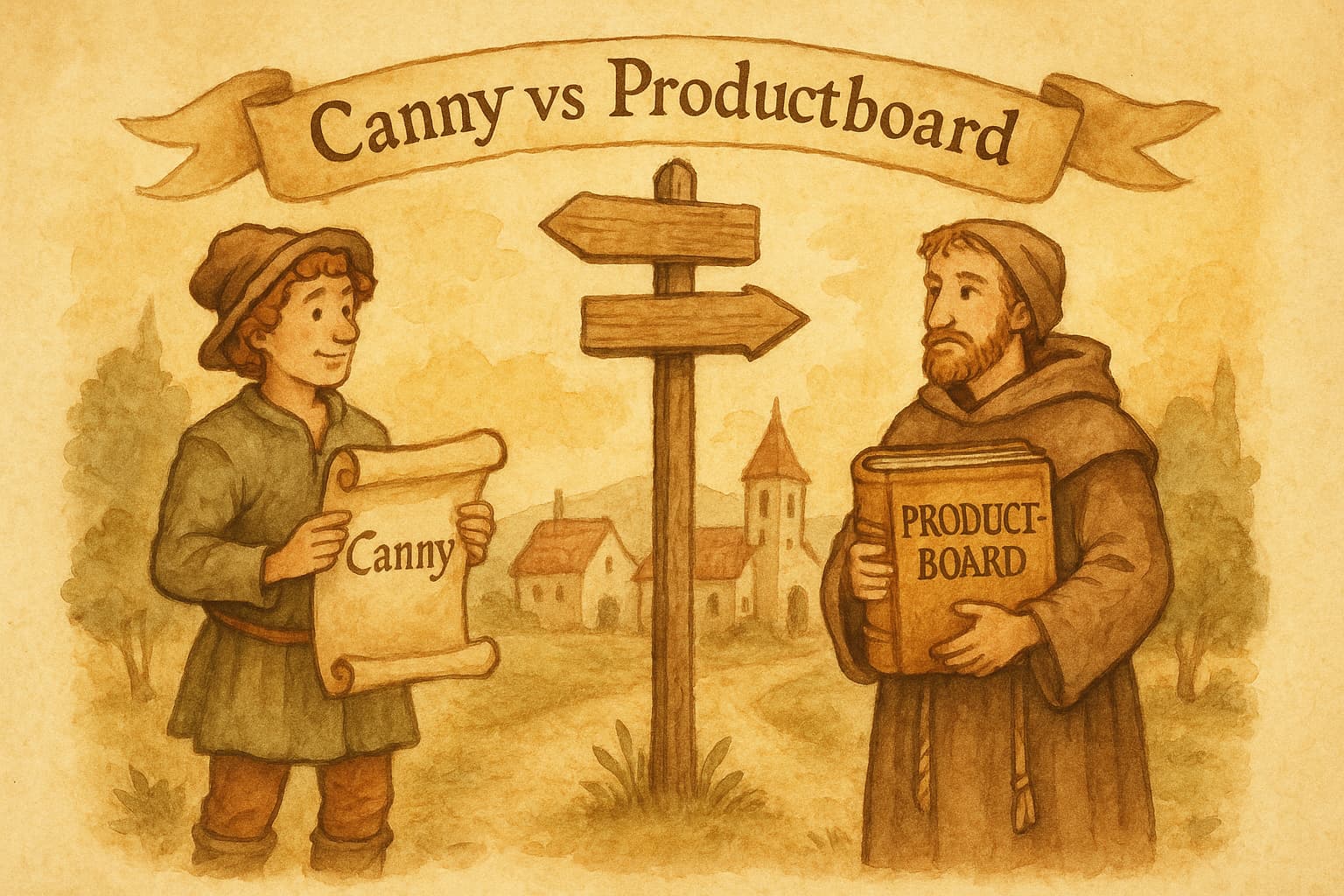
Canny vs Productboard: Which One Do You Actually Need?
Your team is drowning in feature requests from Slack, support tickets, and sales calls. You need a system. You've narrowed it down to Canny and Productboard. Both promise to help you prioritize what to build next. Both have feedback collection. Both have roadmaps.
But they're built for different teams at different stages, and the pricing gap between them is massive. Here's what actually matters.
The 30-Second Version
Canny is a feedback management tool. Users submit ideas, vote on them, and you prioritize based on demand. It's simple, focused, and starts at $79/month for tracked-user pricing.
Productboard is a product management platform. It centralizes feedback from multiple sources, maps it to features, scores priorities with weighted frameworks, and manages roadmaps. It starts free but the useful plans run $19-59/maker/month.
Canny is built for teams that want users to tell them what to build. Productboard is built for PMs who want to synthesize feedback with strategy.
Pricing Compared
This is where the decision gets real.
Canny Pricing (2026)
| Plan | Price | What You Get |
|---|---|---|
| Free | $0 | 1 board, 100 tracked users |
| Starter | $79/mo | 1 board, 1,000 tracked users, custom domain |
| Business | $399/mo | Unlimited boards, 5,000 tracked users, integrations, AI |
| Enterprise | Custom | SAML SSO, SLA, custom limits |
Canny charges by tracked users. Once you pass the limit on your plan, you need to upgrade. A team with 500 active feedback users pays $79/month. At 2,000 users, you're looking at $399/month.
Productboard Pricing (2026)
| Plan | Price | What You Get |
|---|---|---|
| Starter | Free | Basic features, limited notes |
| Essentials | $19/maker/mo | Feedback portal, insights, basic roadmap |
| Pro | $59/maker/mo | Customer segments, custom statuses, advanced prioritization |
| Enterprise | ~$300-400/maker/mo | SAML, audit logs, advanced permissions |
Productboard charges per "maker" (team members who can edit and prioritize). Contributors and viewers are free. A team of 5 PMs on Pro pays $295/month. On Enterprise, that same team pays $1,500-2,000/month.
There's also a $20/maker/month AI add-on for feedback summarization and pattern detection.
The Real Cost Comparison
For a team of 3 product managers with ~1,000 active feedback users:
- Canny Starter: $79/month
- Productboard Pro: $177/month ($59 x 3 makers)
For a team of 5 PMs with 3,000 feedback users:
- Canny Business: $399/month
- Productboard Pro: $295/month ($59 x 5 makers)
The math flips depending on whether you have more PMs or more feedback users. Canny gets expensive as your user base grows. Productboard gets expensive as your PM team grows.
Feature Comparison
Where Canny Wins
Simplicity. Canny does one thing well: collect and organize feedback. Users submit ideas, other users vote, you see what's popular. There's no learning curve. Your team is productive on day one.
Public feedback boards. Canny's boards are designed to be public-facing. Users see what others have requested, add their votes, and feel heard. It creates a community effect around feature requests.
Changelog. Canny includes a built-in changelog. When you ship a feature that users requested, you can close the loop by marking it as complete and notifying voters. Productboard has no changelog.
Tracked-user pricing. If you have a large PM team but a small user base, Canny is cheaper. Three PMs and 500 users? $79/month vs $177/month on Productboard.
Where Productboard Wins
Feedback synthesis. Productboard doesn't just count votes. It lets you collect feedback from multiple sources (Intercom, Zendesk, Slack, email, calls), attach notes to features, and score priorities using weighted frameworks. For PMs managing complex product portfolios, this depth matters.
Strategic prioritization. Productboard's prioritization matrix lets you weight features against multiple criteria: user impact, effort, strategic alignment, revenue potential. Canny's prioritization is essentially "sort by votes." If your product strategy is more nuanced than "build the most-requested thing," Productboard gives you better tools.
Roadmap flexibility. Productboard's roadmaps can show different views for different audiences (executives, engineering, customers) with different levels of detail. Canny's roadmap is simpler: a Kanban board showing what's planned, in progress, and done.
Enterprise readiness. SOC 2, SAML SSO, audit logs, advanced permissions, dedicated CSM. If your procurement team has a checklist, Productboard checks more boxes.
Integrations depth. Productboard integrates with Jira, Azure DevOps, GitHub, Intercom, Zendesk, Salesforce, Slack, and more at a deep level. Feature specs can sync bidirectionally with Jira tickets. Canny has integrations too, but they're less mature for enterprise workflows.
The Changelog Gap
Here's something neither tool does well: communicating what you shipped.
Canny has a changelog feature, but it's basic. You write entries manually. There's no AI generation from your issue tracker, no email campaigns to your user base, no in-app announcement widgets.
Productboard has no changelog at all. It's a planning tool, not a communication tool. Once you decide what to build and track it through development, Productboard's job is done. Telling users about it? That's your problem.
This is the gap that tools like Worknotes fill. You plan and prioritize in Canny or Productboard. You build in Linear or Jira. Then Worknotes generates the user-facing update from your completed tickets, publishes it to your changelog, sends it via email, and announces it in-app.
Planning what to build and communicating what you built are two different jobs. Using the right tool for each is more effective than forcing one tool to do both.
When to Choose Canny
Canny is the better choice when:
- You want users to drive prioritization. If public voting boards and community feedback are central to your product strategy, Canny is built for exactly this.
- Your team is small. One or two PMs who need a simple system to collect and organize feedback. Canny's lack of complexity is a feature, not a limitation.
- You want a built-in changelog. If you need feedback + changelog in one tool and don't want to manage two platforms, Canny covers both (though the changelog is basic).
- Your user base is small. Under 1,000 tracked users, Canny's Starter plan at $79/month is hard to beat for what you get.
When to Choose Productboard
Productboard is the better choice when:
- You manage a complex product portfolio. Multiple product lines, multiple stakeholder groups, competing priorities that need weighted scoring. Productboard's strategic tools are built for this complexity.
- Feedback comes from everywhere. Sales calls, support tickets, Slack, email, user research. If you need to centralize unstructured feedback from 6 channels and synthesize it, Productboard's note-taking and feedback mapping is significantly better.
- You need enterprise features. SOC 2, SAML, audit logs, advanced permissions. If your company requires these, Productboard has them. Canny's enterprise plan is custom and less documented.
- Your PM team is large but your user base is small. 10 PMs and 500 active users? Productboard Pro at $590/month might be cheaper than Canny Business at $399/month, and you get much more powerful prioritization tools.
The Third Option: Use Both (Sort Of)
Some teams use Canny for public-facing feedback (users submit and vote) and Productboard for internal prioritization (PMs synthesize and score). It works, but it means paying for two tools and keeping them in sync.
A simpler split: use one tool for feedback and prioritization, and a separate tool for communicating what you shipped. The planning-to-communication pipeline looks like this:
- Collect feedback in Canny or Productboard
- Plan and prioritize based on votes, scoring, or strategy
- Build in Linear, Jira, or your issue tracker
- Communicate using a dedicated tool like Worknotes (AI-generated updates, email campaigns, in-app announcements)
Each tool does its job well. No tool is forced to be something it's not.
Bottom Line
Choose Canny if you want simplicity, public feedback boards, and a built-in changelog for teams with fewer than 5 PMs and under 5,000 tracked users.
Choose Productboard if you need strategic prioritization, enterprise compliance, and deep feedback synthesis for a growing PM team managing a complex product.
Choose neither for communicating product updates. That's a different job.
Worknotes generates product updates from your Linear tickets and distributes them via changelog, email, and in-app widgets. Pair it with Canny or Productboard for the full cycle. Start your free trial →
Senior PM in ticketing and events (B2B). Built Worknotes to solve the product update problem he kept seeing: teams ship fast but communicate slow. Previously engineering management at Johns Hopkins.
@buildwithfedeA better way to share product updates
Worknotes is a platform for creating and sharing product updates across changelogs, email, and in-app announcements, without slowing down your team.